HYROX Open vs Pro: Which Division Should You Enter?
HYROX Open vs Pro is the same race at different weights: only five stations change. The exact load jumps, who each division suits, and a simple gym test to pick the right one.
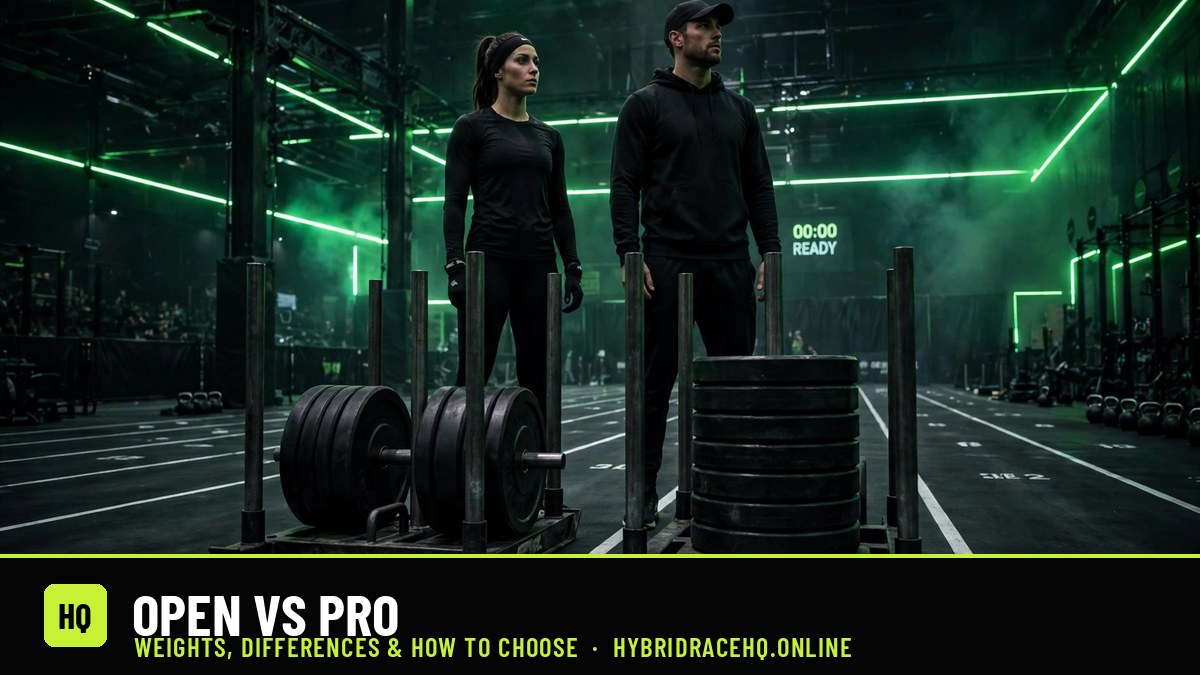
In HYROX Open vs Pro, the course never changes: same 8 × 1 km runs, same station order, same distances. Pro simply loads five stations heavier — sleds +50 kg, farmers carry +8 kg per hand, sandbag +10 kg, wall ball +2–3 kg. Women Pro races on exactly the Men Open weights. No qualification is needed for Pro, but almost every first-timer should start in Open.
HYROX Open vs Pro: what actually changes
The HYROX Open vs Pro decision confuses new racers because the names suggest different races. They are not. Both divisions run the identical course in the identical order: 1 km of running before each of the eight stations, the same SkiErg and rowing distances, the same 80 m of burpee broad jumps, the same 100 wall balls. Three stations — the runs, SkiErg, rowing and burpees among them — carry no load at all and are exactly equal.
What changes is confined to the five loaded stations, and it changes a lot: the Pro loads are roughly a third to a full double heavier depending on the station and division. That extra load doesn't just slow the stations themselves; it taxes the runs that follow them, which is where the real time difference between divisions hides. Understanding that one idea — Pro is a running penalty earned at the stations — is the key to choosing well.
HYROX Pro vs Open weights: the full table
These are the HYROX Pro vs Open weights from the current rulebook (sled totals include the sled itself). The jump column shows what you are really signing up for:
| Station | Women Open | Women Pro | Jump | Men Open | Men Pro | Jump |
|---|---|---|---|---|---|---|
| Sled push (4 × 12.5 m) | 102 kg | 152 kg | +49% | 152 kg | 202 kg | +33% |
| Sled pull (4 × 12.5 m) | 78 kg | 103 kg | +32% | 103 kg | 153 kg | +49% |
| Farmers carry (200 m) | 2 × 16 kg | 2 × 24 kg | +50% | 2 × 24 kg | 2 × 32 kg | +33% |
| Sandbag lunges (100 m) | 10 kg | 20 kg | +100% | 20 kg | 30 kg | +50% |
| Wall balls (100 reps) | 4 kg | 6 kg | +50% | 6 kg | 9 kg | +50% |
Read the jumps, not just the weights. The women's sandbag doubles. The men's sled pull jumps by nearly half. And these loads arrive in the back half of a race that has already taken most of your energy — the wall ball jump lands at station eight, on legs that have run 8 km. For the complete station-by-station picture, including the unloaded stations, see all 8 HYROX stations explained.
The detail everyone misses: Women Pro = Men Open
Look across the table and a deliberate calibration appears: Women Pro and Men Open use identical weights at every loaded station — the same sleds, the same kettlebells, the same sandbag, the same wall ball. The divisions form three load tiers, not four: Women Open, then Women Pro / Men Open together, then Men Pro on top.
One thing does not follow the tier: the wall ball target. Target height is set by gender — 2.70 m for women, 3.00 m for men — in both divisions. So a woman stepping up to Pro throws a heavier ball at the same target, while a man stepping up throws a heavier ball at his same, higher target. Small detail, but it changes how the final station feels for each group, and it is exactly the kind of thing worth knowing before you choose rather than after.
Fields, waves and finish times
Pro fields are much smaller than Open fields, and they look different: fewer first-timers, more experienced racers, a more serious start-line atmosphere, and often earlier or later waves in the day. The surprising statistic is that Pro averages are faster than Open averages despite the heavier loads — third-party analyses of results data put average Pro finishes several minutes ahead of Open. That is pure self-selection: the Open average includes tens of thousands of first races, while almost nobody wanders into Pro by accident.
For you, personally, the maths runs the other way. The same athlete racing Pro instead of Open should expect to be roughly 5–15 minutes slower, and the time is rarely lost at the stations themselves — it leaks away in the runs after the sleds and lunges, where heavier work has taxed the legs. Compare your Pro time against other Pro times, never against your Open personal best; they are different events wearing the same course.
Pro is the road to the World Championships
There is one competitive reason to choose Pro that has nothing to do with ego: it is the qualifying pathway. Elite 15 places at major races and qualification for the HYROX World Championships are earned through Pro division results during the season. Open results, however fast, do not count toward that pathway (with one exception: athletes aged 60+ qualify through the Open division). So if your ambition genuinely extends to championship racing, Pro is not optional — it is the door. For everyone else, that fact is trivia, not pressure: Open has its own age-group rankings and podiums at every event.
Should you enter HYROX Open or Pro? The readiness test
Strip away the marketing and the choice is simple. Enter Open if this is your first race (whatever your gym numbers say — the course, the transitions and the sled surface are all unknowns), if your running is your limiter, or if you are chasing a personal best time. Consider Pro if you have finished Open feeling the stations were comfortable, or if you are targeting championship qualification. Then settle it with evidence, not feelings — in training, at race weights:
| Readiness test (Pro loads) | Pass mark |
|---|---|
| Sled push 4 × 12.5 m at Pro weight | Completed without a mid-length stop — then run 1 km within ~30 sec/km of your normal pace |
| Sled pull 4 × 12.5 m at Pro weight | Sled keeps moving with rope technique; no long stalls |
| Farmers carry 200 m at Pro weight | Finished with at most two short, planned set-downs |
| Sandbag lunges 100 m at Pro weight | Completed in a few planned sets, knees and balance under control |
| Wall balls 100 reps at Pro weight | Finished in planned sets (e.g. 4 × 25) without no-rep streaks |
Pass all five fresh and you are Pro-ready on paper — ideally, repeat the sled and wall ball tests at the end of a hard training session, because that is the state you'll actually meet them in. Fail one or two and the answer is not "never Pro"; it is "Open this season, Pro after a strength block," which is how most Pro racers actually got there. A structured build like our 12-week plan closes exactly these gaps.
Common Open vs Pro mistakes
- Choosing Pro for a first race because the gym felt easy — gym sleds on gym floors, fresh, are not race sleds at minute 40.
- Comparing a Pro time to an Open PB — different loads, different event. The comparison only ever demoralises.
- Assuming Pro needs qualification and never entering — it doesn't. When you're ready, you just choose it at booking.
- Ignoring the percentage jumps — +50 kg sounds abstract; +49% on a sled pull, at kilometre three, does not feel abstract.
- Choosing Open "forever" out of habit — if stations feel easy and you want the championship pathway or a new test, Pro is the honest next step.
Open teaches you the race. Pro tests whether the race taught you anything. Do them in that order and both feel right.
Still deciding whether HYROX itself is your sport? Our HYROX vs CrossFit comparison zooms out one level further.
Frequently asked questions
Do you need to qualify for HYROX Pro?
No. Anyone aged 16 or over can enter the Pro division simply by choosing it when buying a ticket — there is no qualifying standard. Qualification only enters the picture at the top end: Elite 15 places and World Championship slots are earned through Pro results during the season.
What is the difference between HYROX Open and Pro weights?
Only five stations change. From Open to Pro the sled push and pull each gain 50 kg, the farmers carry kettlebells gain 8 kg per hand, the sandbag gains 10 kg, and the wall ball gains 2–3 kg. The runs, SkiErg, rowing and burpee broad jumps are identical.
Are Pro times faster than Open times?
On average, yes — Pro fields average faster finish times despite heavier weights, because only confident, experienced athletes enter them. For the same athlete, though, Pro is slower: expect roughly 5–15 minutes more than your Open time, lost mostly in the runs after the heavy sleds.
Which HYROX division is best for a first race?
Open, for essentially every first-timer. Your first race teaches you pacing, transitions and how the sled surface feels — lessons better learned at Open loads. Pro will still be there for your second season, and you'll know exactly what you're signing up for.
Can I change from Open to Pro after entering?
Division changes depend on the event's policies and remaining Pro wave capacity, and often involve a transfer process and fee through the ticketing platform. Decide before you book if you can — and if you're torn, the readiness test in this guide settles it.
Want more like this? Browse the Start Here category.
Fitness disclaimer: Training involves physical risk. The content on this page is educational and is not medical advice. Consult a qualified professional before starting a new training program, especially if you have any health condition or injury.