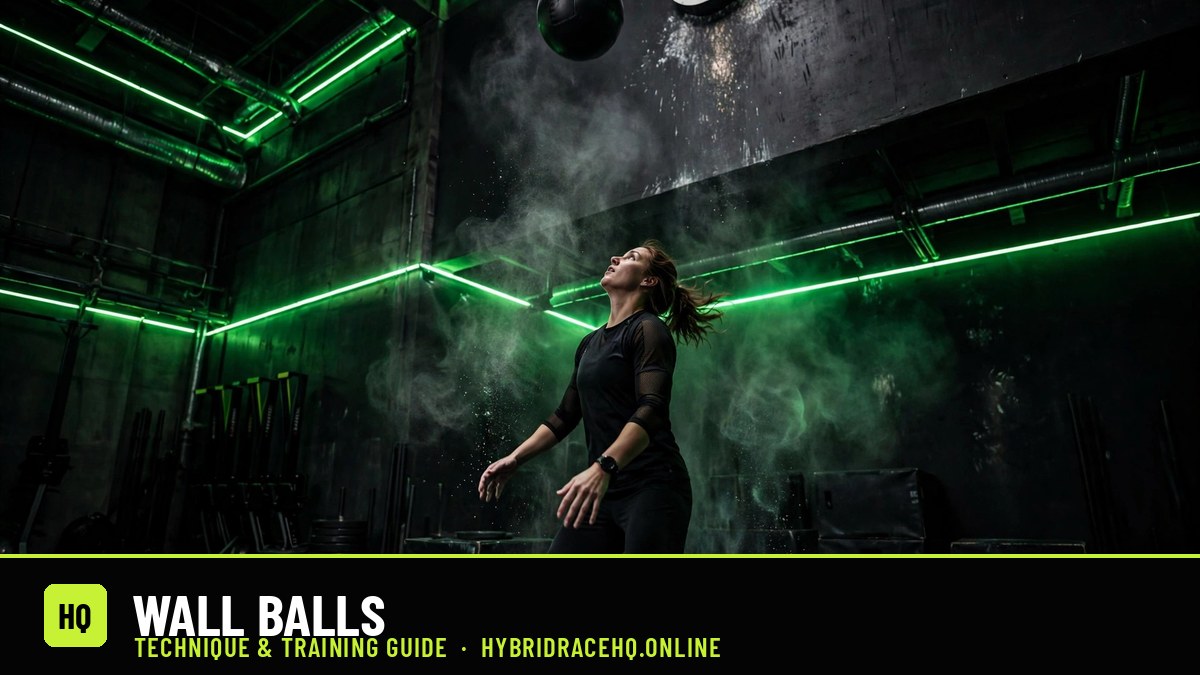
HYROX Wall Balls: Technique and Training Guide
HYROX wall balls close every race: 100 reps with a 4–9 kg ball at a 2.70 m or 3.00 m target. The technique, the rules judges enforce, rep schemes that work, and how to train for the last station.
HYROX wall balls are station 8 of 8: 100 reps in every division. The ball is 4 kg (Women Open), 6 kg (Women Pro / Men Open) or 9 kg (Men Pro), thrown to a target at 2.70 m for women and 3.00 m for men. Every rep needs a full squat — hip crease below the knee — and visible contact with the target. Technique in one line: squat deep, throw with your legs, catch the ball straight into the next squat.
HYROX wall balls: the official numbers
Wall balls are the final station of the race, and they are deliberately placed there: the movement itself is simple, but it arrives when nothing about you is fresh. The standards below are from the current rulebook.
| Division | Reps | Ball weight | Target height |
|---|---|---|---|
| Women Open | 100 | 4 kg (≈9 lb) | 2.70 m |
| Women Pro | 100 | 6 kg (≈13 lb) | 2.70 m |
| Men Open | 100 | 6 kg (≈13 lb) | 3.00 m |
| Men Pro | 100 | 9 kg (≈20 lb) | 3.00 m |
One warning before anything else: older content all over the internet still lists Women Open as 75 reps. That was the 2025/26 standard. Under the current rulebook it is 100 reps for everyone — if your training plan says 75, it is out of date, and race day will not care. Note also that target height follows gender, not division: moving from Open to Pro makes the ball heavier, not the target higher. See how this station fits the full course in our guide to all 8 HYROX stations.
The rules judges actually enforce
Every racer has a judge counting reps at this station, and three standards decide whether a rep counts:
- Squat depth. Your hip crease must drop below the top of your knee on every rep. Half-squats are the single most common no-rep — and they creep in exactly when fatigue arrives, around rep 40 onwards.
- Target contact. The ball must visibly hit the wall at or above the target line. A near miss is a no-rep, and no-reps still cost you the energy of the throw.
- A clean catch. The ball is caught with two hands in front of your chest. You cannot bounce it off the floor and catch it, and you cannot use your knee to help the ball up.
The practical takeaway: a slightly slower rep that clearly satisfies depth and target beats a fast rep your judge waves off. Racers lose more time to clusters of no-reps in the final 30 than to any pacing decision they made earlier.
Wall ball technique, step by step
1. Set your distance and stance
Stand roughly an arm's length from the wall — about 30–50 cm — with feet shoulder-width apart and toes turned out slightly. Too close and the throw goes straight up, demanding shoulder strength you won't have at rep 80. Too far and you start reaching, which leaks height and accuracy. Find your spot in training and walk straight to it on race day.
2. Squat like a squat, not a hinge
Hold the ball at your chest, elbows under it. Drop straight down, hips back and below the knee crease, knees tracking over toes, chest tall. The straighter your squat's vertical line, the less energy each rep wastes — across 100 reps, small leaks become minutes.
3. Throw with your legs, guide with your arms
The throw is produced by extending your hips and knees, the same drive as a jump without leaving the floor. Your arms finish the movement; they should never be the engine. Athletes who throw with their shoulders feel fine for 20 reps and then fall apart — shoulders are a small muscle group being asked to do a leg job.
4. Catch into the next squat
Receive the ball at your chest as you are already descending into the next rep. Catching while standing, pausing, then squatting again doubles the work: two movements per rep instead of one rhythm. The best wall ball sets look almost mechanical — down, up, ball goes, ball returns, down again, with no visible pause anywhere.
5. Breathe on a pattern
Inhale as you descend, exhale as you throw. A fixed breathing rhythm is a pacing device: when your breathing breaks pattern, your rep speed is about to break too, and that is your signal to take a planned short rest instead of grinding into no-rep territory.
Rep schemes: how to break up 100 reps
Almost nobody should attempt 100 unbroken in a first race. The fastest total time usually comes from planned sets with short, disciplined rests — you stop before you fail, so every set stays clean.
| Your level | Rep scheme | Rest between sets |
|---|---|---|
| First race | 10 × 10 | 5–10 seconds, hands on hips, two deep breaths |
| Some wall ball training | 20-20-15-15-10-10-10 | 10–15 seconds |
| Experienced | 4 × 25 or 2 × 50 | 10–20 seconds |
| Competitive | Unbroken, or one short break at 50–60 | Only if trained for it |
The mistake pattern judges see every race: an athlete opens with 30 fast reps, then survives the rest in sets of 3 and 2 with long hands-on-knees rests. Total time is almost always worse than the athlete who held sets of 10 from the very first rep. Decide your scheme before you reach the station — mid-station is no place to negotiate with yourself.
How to train for HYROX wall balls
Wall balls respond to two kinds of training: volume tolerance (can your legs and shoulders repeat the movement?) and fatigue tolerance (can you repeat it after running?). Train both, once or twice a week, inside a structure like our HYROX workout plan.
| Session | Workout | Purpose |
|---|---|---|
| Volume day | 5 × 20 at race weight, 60 seconds rest | Groove depth and target consistency without exhaustion |
| Strength support | Front squats 4 × 6–8, thrusters 3 × 10–12 | Build the leg drive and overhead finish |
| Fatigue day | 3 rounds: 1 km run at race effort + 30 wall balls | Rehearse the exact sensation of station 8 |
Two equipment notes. Train with a proper rubber wall ball at race weight, not a sand-filled slam ball — the rebound and catch feel completely different. And you need a wall and ceiling height that let you practise at the real target: throwing to a lower mark in training grooves a throw that comes up short on race day.
Progress patiently. If you currently break sets at 10, spend three to four weeks making sets of 15 automatic before chasing 20s. Wall ball capacity builds quietly and then all at once.
Race-day strategy for the last station
- Arrive and reset. You reach wall balls straight from 100 m of sandbag lunges. Use your first three to five reps to find rhythm, not speed — depth, target, breathing.
- Talk to your judge early. A quick check that your depth and target contact look good on the first set prevents a no-rep argument at rep 70.
- Hold your scheme. Whatever you planned — 10s, 15s, 20s — start it from rep one. The urge to bank extra reps early is the station's oldest trap.
- Keep rests standing and short. Hands on hips, eyes on the target, two breaths, go. Sitting down or wandering off turns 10-second rests into 30-second ones.
- Know the shoe rule. Wall balls are the one station where the rulebook allows you to remove your shoes. Most racers keep them on — but if your race shoes have a tall, wobbly heel, barefoot reps are legal and steadier.
Common HYROX wall ball mistakes
- Throwing with the arms — the classic. Legs drive, arms guide; shoulder-thrown reps die around rep 30.
- Catching standing, then squatting — two movements per rep, double the fatigue. Catch into the descent.
- Squats getting shallower as fatigue builds — every short rep is a no-rep you paid full price for.
- Going out unbroken in a first race — a heroic first 30 followed by sets of 3 is slower than steady 10s.
- Training with the wrong ball or a low target — slam balls don't rebound like wall balls, and a low target builds a short throw.
- Standing too far from the wall — reaching throws lose height and spray no-reps when you're tired.
Wall balls don't test whether you can do 100 reps. They test whether your 90th rep looks like your 10th — and that's a technique and pacing skill, not a fitness test.
Wall balls end the race — but the station before them sets the trap. Read our sled push guide for the other end of the course, where races are quietly lost in the first ten minutes.
Frequently asked questions
How many wall balls are in HYROX?
100 reps in every division under the current rulebook — including Women Open, which was 75 reps in the 2025/26 season. Check any older guide you find against that change, because a lot of content online still shows the old number.
How heavy is the wall ball in HYROX?
4 kg for Women Open, 6 kg for Women Pro and Men Open, and 9 kg for Men Pro. The target is 2.70 m for women and 3.00 m for men — target height follows gender, not division.
What counts as a no-rep in HYROX wall balls?
A rep doesn't count if your hip crease doesn't drop below the top of your knee in the squat, or if the ball doesn't visibly touch the target at or above the line. Catching the ball off a bounce from the floor is also not allowed.
How do I do HYROX wall balls unbroken?
Unbroken 100s are built, not willed: train sets of 20–25 at race weight weekly, master catching the ball directly into the next squat, and throw with your legs so your shoulders stay fresh. Most first-timers are faster with planned sets of 10–15 than with a failed unbroken attempt.
Why do wall balls feel so hard at the end of a HYROX race?
Because they arrive after 8 km of running, two sled stations and 100 m of sandbag lunges. Your legs, shoulders and lungs are all pre-fatigued, which is exactly why technique and a pre-planned rep scheme matter more at this station than raw fitness.
Want more like this? Browse the Stations category.
Fitness disclaimer: Training involves physical risk. The content on this page is educational and is not medical advice. Consult a qualified professional before starting a new training program, especially if you have any health condition or injury.