HYROX Sled Pull Technique: Weight, Rules and Training
Good HYROX sled pull technique is the difference between a three-minute station and a six-minute wrestling match. The pull comes third, straight after the sled push, and it is the only station where the implement moves toward you — which means the winners are not the strongest pullers, but the ones whose bodyweight does the work while their hands just gather rope. Here's the weight, the rules, and the technique that makes 50 metres feel manageable.
In HYROX you pull the sled 4 × 12.5 m at 78 kg (Women Open), 103 kg (Women Pro / Men Open) or 153 kg (Men Pro), including the sled. Sled pull technique in one line: hips back, lean away from the sled, walk backwards to move it with your bodyweight, gather the rope hand over hand without ever letting it go slack — and stay standing inside your Racers Box.
Sled pull weight: the official numbers
The sled pull is station 3 of 8. As with the push, the totals below come from the official rulebook and include the sled itself:
| Division | Sled pull weight | Distance |
|---|---|---|
| Women Open | 78 kg (≈172 lb) | 4 × 12.5 m |
| Women Pro | 103 kg (≈227 lb) | 4 × 12.5 m |
| Men Open | 103 kg (≈227 lb) | 4 × 12.5 m |
| Men Pro | 153 kg (≈337 lb) | 4 × 12.5 m |
The pull weights are roughly three-quarters of the push weights — but the pull feels harder for many athletes, because it arrives on legs the push has already emptied, and because a rope rewards technique far more than brute force.
The sled pull rules that matter
- Work from your Racers Box. You and the sled start inside marked boxes at each end of your assigned lane. While holding the rope, you can't step on the solid lines at the front or back of your box.
- Stay standing. Pulling seated or kneeling is not allowed — you must remain on your feet for the whole station.
- Keep the rope in your lane. The rope may run out of the back of your lane, but it can't obstruct the lane next to you. Stack your gathered rope to one side, inside your lane.
- Chalk is allowed — the sled pull and farmers carry are the only stations where you may use it, and only the chalk the event provides.
None of these rules is hard to follow — but all of them are hard to remember at minute 25 of a race with a heart rate of 170. Rehearse them in training until they're automatic.
HYROX sled pull technique, step by step
1. Set your base
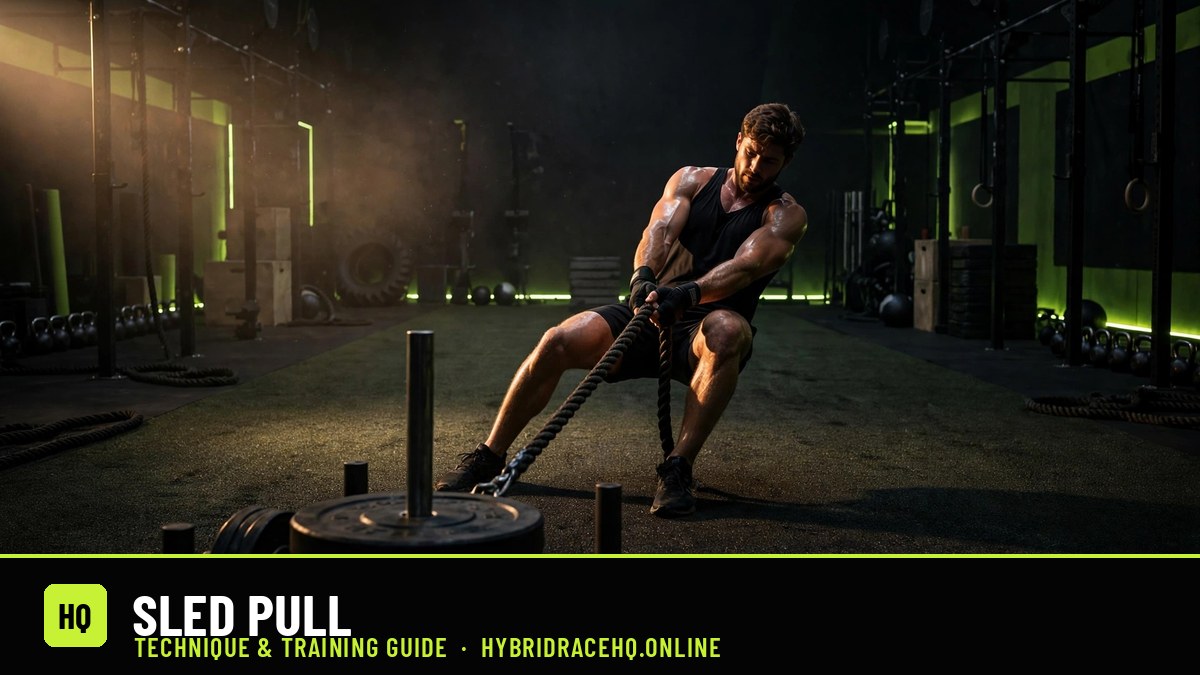
Feet wider than shoulder-width, toes slightly out, weight through your heels. Push your hips back and down into a quarter squat, lean back slightly against the load, chest proud and core braced — like the start of a heavy deadlift, facing the sled.
2. Take out the slack first
Reach forward to full arm extension and pull the rope in until it's tight and you can feel the sled's weight. Wrap your whole hand around the rope, thumbs included. Every length that starts with slack starts with a jerk — and jerks stall sleds.
3. Move your body, not just the rope
This is the core of HYROX sled pull technique: the sled follows your centre of mass. Sit your hips back and travel backwards, letting your arms gather what your body has already earned. Drive each pull long — arm fully extended, elbow driving back like a heavy bent-over row, hand finishing at your belly.
4. Keep the rope under tension
Small, continuous gathers beat big sweeping pulls. The moment the rope goes slack, the sled decelerates — and a stopped sled costs far more to restart than a moving one costs to keep moving. The other hand should already be reaching as the first finishes.
5. Stack the rope and reset fast
Let the gathered rope fall to one side of you in a neat pile, never between your feet. When the whole sled crosses the line, run to the other end — the walk back is on the clock, and it's the cheapest time on the station. Grab, tension, pull: no standing around.
Walk back or hand over hand?
You'll see two styles on the race floor. The walk-back uses your legs and bodyweight: you lean away and step backwards, dragging the sled with your mass while your hands feed the rope through. The hand-over-hand style plants your feet and rows the rope in with your back and arms.
For most athletes, the fastest and most sustainable approach is a blend: walk backwards in small steps to generate the movement, and gather hand over hand continuously so the rope never piles up in front of you. Pure hand-over-hand from a tall, static stance is the slowest version — it loads the smallest muscles you have and leaves nothing for the farmers carry. Save the static style for the final metres of a length, when your box runs out.
Grip economy ties it together. A clenched fist is a slow fist: let the rope run through a relaxed hand and close only enough to pull. Grip is a shared currency across the back half of this race — spend it here carelessly and the farmers carry collects the debt.
How to train the sled pull
One pull session a week, alongside the push work in our sled push guide, builds everything this station needs:
| Session | Workout | Purpose |
|---|---|---|
| Technique day | 6 × 12.5 m at 80–90% of race weight, walk-back style, full recovery | Groove the lean, the gathers and tidy rope stacking |
| Strength day | 4 × 12.5 m at race weight +10%, plus heavy bent-over rows 4 × 6 | Build the back and grip force to move any sled |
| Race-sim day | Sled push 25 m straight into sled pull 25 m, × 2, after an 800 m run | Rehearse the real station order on tired legs |
No sled at your gym? Heavy rows, deadlifts, towel pull-ups and rope pulls build most of the strength — but chase down a real sled for at least two sessions before race day, because rope handling under friction is a skill of its own.
Common sled pull mistakes
- Standing tall and pulling with the arms — the slowest way to do this station. Sit back and let your bodyweight drag the sled.
- Letting the rope go slack — a stopped sled is the most expensive object in HYROX. Small, continuous gathers.
- Big, sweeping pulls — they feel productive and leave gaps where the sled dies. Short and relentless wins.
- Rope between your feet — a tangled reset costs more than any single pull saves. Stack it to one side.
- Walking the return — the trip back to the other end is timed. Jog it, every length.
- Death-gripping the rope — forearms spent here are forearms missing at the farmers carry.
The push asks whether you can drive force into the floor. The pull asks something subtler: whether you can move a rope with your body instead of your arms, without ever letting the sled stop.
The pull is one of eight stations — see how it fits the full race in our guide to all the HYROX stations.
Frequently asked questions
How heavy is the sled pull in HYROX?
The sled pull total weight (including the sled) is 78 kg for Women Open, 103 kg for Women Pro and Men Open, and 153 kg for Men Pro, pulled over 4 × 12.5 m with a rope.
What is the best HYROX sled pull technique: walking back or hand over hand?
Most athletes are fastest combining both: lean back and walk backwards to move the sled with bodyweight, gathering the rope hand over hand as you go. Pure arm pulling from a static stance is the slowest option because it relies on the smallest muscles.
Can you sit or kneel during the HYROX sled pull?
No. The rulebook requires you to stay standing inside your Racers Box while pulling — seated or kneeling pulls are not allowed — and while holding the rope you cannot step on the lines at the front or back of the box.
How do I train the sled pull without a sled?
Heavy bent-over rows, deadlifts and chest-supported rows build the pulling strength, while rope climbs, towel rows and battle-rope pulls mimic the grip and hand-over-hand action. Find a real sled for at least a couple of sessions before race day if you can — the friction feel is hard to replicate.
Why does my grip fail on the sled pull?
Usually because the arms are doing work the body should do. Leaning back and moving your bodyweight backwards takes load off the hands, and gripping only as hard as needed — rather than strangling the rope — preserves your forearms for the farmers carry later in the race.
Want more like this? Browse the Stations category.
Fitness disclaimer: Training involves physical risk. The content on this page is educational and is not medical advice. Consult a qualified professional before starting a new training program, especially if you have any health condition or injury.